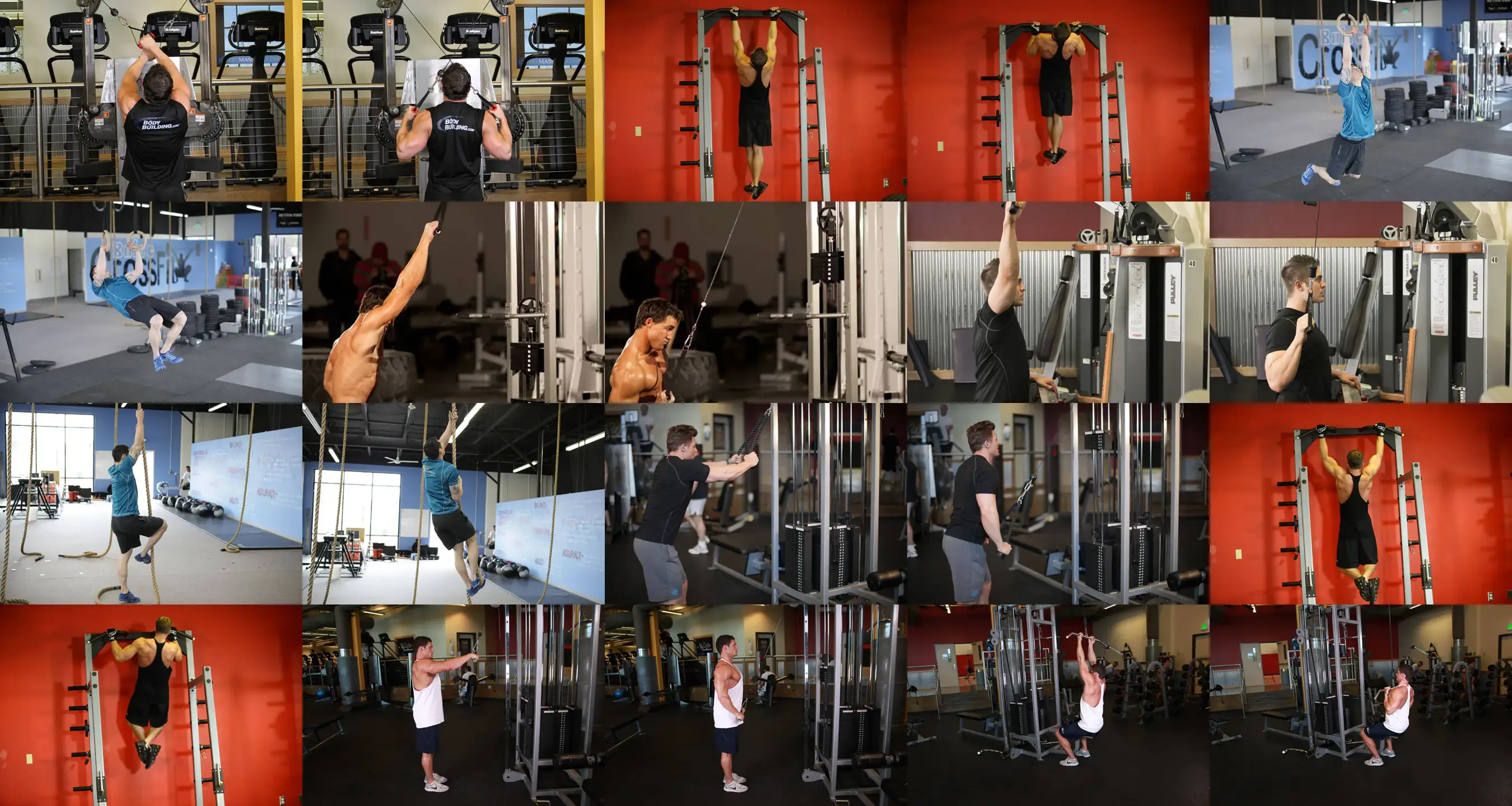
Setup and loading
Use a straight bar with an overhand grip well wider than your shoulders. Adjust difficulty with grip width and how close you get to the hand; if you cannot control the descent, use a band.
How to do the side-to-side pull-up step by step
- Hang from the bar with a wide overhand grip, arms straight, shoulder blades engaged, abs tight, and legs together.
- Breathe in, pull your shoulder blades down, and start pulling while shifting your body toward your right hand.
- Rise until your chin clears the bar near your right hand, with your left arm nearly straight as support.
- Exhale at the top, pause briefly, then lower slowly along the same path until you are centered with straight arms.
- On the next rep, pull toward your left hand, following the same path toward the other side.
- Alternate sides until the set is done, counting each side as one rep or each pair as one rep.
Form cues
- Bring your chin toward the working hand
- The opposite arm assists; it does not pull
- Return to center with fully straight arms
- Keep your legs still with no swinging
Common mistakes
- Dropping fast: you lose the eccentric and stress your elbow; lower over two to three seconds.
- Swinging side to side: momentum does the work; settle at center before every rep.
- Pulling evenly with both arms: it defeats the purpose; bring your chin closer to the working hand.
- Shrugging on the working side: it loads the neck; keep your shoulder blades down throughout.
How to make it easier or harder
To regress, use a band or do archer pull-ups with your feet on a box. To progress, move to archer pull-ups with the support arm fully straight, then to assisted one-arm pull-ups.
Sets and reps for your goal
Hypertrophy
3-4 x 8-12 · rest 60-90 s3-4 sets of 6-12 reps (up to 15-20 on isolation exercises) at 65-80% of your max. Rest 1 to 2 minutes.
Get close to failure (0-3 reps in reserve) and control the lowering for 2-3 seconds. Accumulate 10-20 sets per muscle per week.
Max Strength
4-5 x 3-6 · rest 2-3 min3-6 sets of 1-6 reps at 80-90% of your max (1RM). Rest 2 to 5 minutes.
Leave 1-3 reps in reserve. If your technique breaks down, lower the weight: strength is built with good reps.
A guide for healthy adults. Adjust the load to your level and see a professional if you have an injury.
Check your form
Film yourself from the side or ask someone to watch, then tick what you get right.
Frequently asked questions
Is it the same as an archer pull-up?
They are very similar. In a side-to-side pull-up the support arm can bend somewhat, while in an archer pull-up it stays straight and helps very little. The archer is the natural next step.
Does it help you get a one-arm pull-up?
Yes, it is a common step because it gradually shifts more of your bodyweight onto one arm. People usually pair it with archer pull-ups, one-arm negatives, and grip work.
Sports it suits
Gear for this exercise
- Pull-up barWall-mounted beats doorway if you plan to add weight.
As an Amazon Associate, Muscle Atlas earns from qualifying purchases.